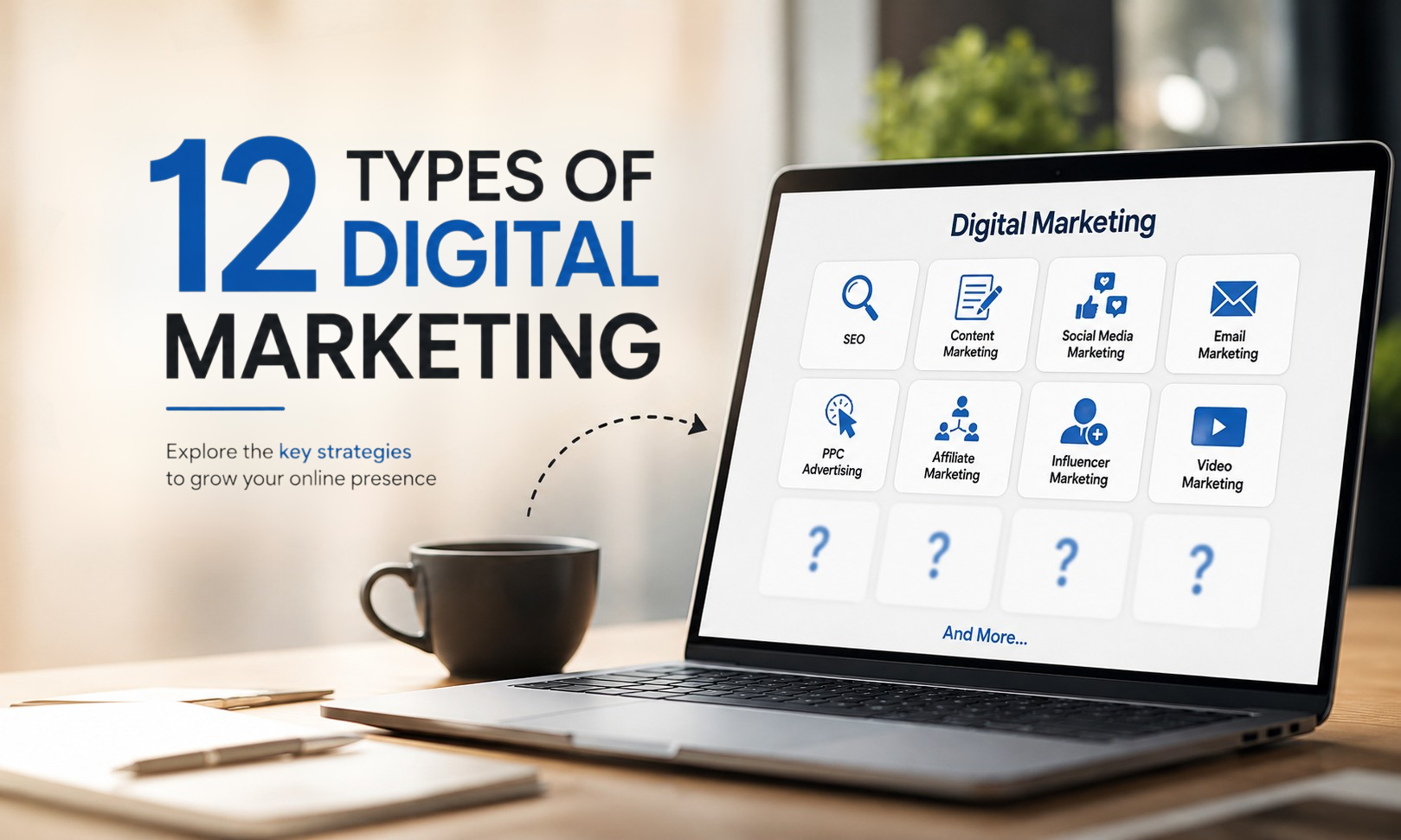
The 12 main types of digital marketing are:
| # | Type of digital marketing | What it does in one line |
|---|---|---|
| 1 | Search engine optimisation (SEO) | Earns unpaid Google rankings that compound over time |
| 2 | Pay-per-click advertising (PPC) | Buys instant placement for high-intent searches |
| 3 | Social media marketing | Builds trust and familiarity through unpaid posting |
| 4 | Paid social advertising | Creates demand and retargets past visitors |
| 5 | Content marketing | Answers buyer questions so you make the shortlist |
| 6 | Email marketing | Sells again to people who already bought |
| 7 | WhatsApp and SMS marketing | Reaches Indian customers where they actually reply |
| 8 | Video marketing | Demonstrates what text cannot explain |
| 9 | Influencer marketing | Borrows trust from someone your buyers follow |
| 10 | Affiliate marketing | Pays commission only on sales delivered |
| 11 | Local SEO and Google Business Profile | Wins “near me” searches for physical businesses |
| 12 | Online reputation management | Controls what appears when people Google your name |
Most articles on this topic list the channels and stop there. That list is easy to find and not very useful, because the real question is never “what types exist?” — it is “which of these should I spend money on, and when will it pay off?”
So this guide gives each type three things a list usually leaves out: what it realistically costs in India, how long before you see a return, and the kind of business it genuinely suits. Some of these will be wrong for you, and the article says so.
The 12 types compared
| Type | Typical monthly cost | Time to results | Best suited to |
|---|---|---|---|
| SEO | ₹15,000 – ₹1,00,000 | 4–8 months | Long-term lead generation |
| PPC / Google Ads | ₹20,000 – ₹5,00,000 | Days | Immediate, high-intent demand |
| Social media marketing | ₹10,000 – ₹60,000 | 3–6 months | Brand building, community |
| Paid social ads | ₹15,000 – ₹3,00,000 | Days to weeks | Ecommerce, app installs, awareness |
| Content marketing | ₹20,000 – ₹1,50,000 | 6–12 months | Considered, research-heavy purchases |
| Email marketing | ₹5,000 – ₹40,000 | Weeks | Repeat sales from existing customers |
| WhatsApp & SMS | ₹3,000 – ₹50,000 | Days | Indian retail, services, reminders |
| Video marketing | ₹25,000 – ₹3,00,000 | 3–9 months | Demonstrable products, education |
| Influencer marketing | ₹10,000 – ₹10,00,000 | Weeks | D2C, fashion, beauty, food |
| Affiliate marketing | 5–30% of sale | 2–4 months | Ecommerce with healthy margins |
| Local SEO | ₹8,000 – ₹40,000 | 2–4 months | Shops, clinics, restaurants, services |
| Reputation management | ₹10,000 – ₹75,000 | 2–6 months | Hospitality, healthcare, education |
Nobody runs all twelve. A business doing well online usually runs three or four properly rather than twelve badly. Spreading a small budget across every channel is the most common and most expensive mistake.
1. Search engine optimisation (SEO)
SEO is the work of getting your pages to rank in Google's unpaid results. It splits into three parts: technical SEO (site speed, crawlability, structure), on-page SEO (content, titles, internal links) and off-page SEO (earning links from other sites).
Its strength is compounding. Traffic that costs nothing per click keeps arriving after you stop paying, which is the opposite of advertising. Its weakness is patience — on a new domain, expect little for the first three or four months.
Choose SEO if there is genuine search demand for your product and you can commit for at least six months. Skip it if you need revenue this quarter, or you sell something nobody knows to search for yet.
2. Pay-per-click advertising (PPC)
PPC puts you at the top of search results immediately, and you pay only when someone clicks. Google Ads dominates, with Microsoft Ads a smaller alternative.
The appeal is speed and control — switch it on today, see leads tomorrow, measure every rupee. The catch is that it stops the moment you stop paying, and competitive keywords in India can run ₹50–₹500 per click. In legal, insurance and education, higher still.
Choose PPC if you need leads now, or want to test whether a keyword converts before committing to SEO. Skip it if your margins are thin, because a ₹200 click that converts one time in fifty needs a ₹10,000 profit per sale to work.
3. Social media marketing
This is the unpaid side — posting, replying, building a following on Instagram, LinkedIn, Facebook, YouTube or X. It builds familiarity and trust rather than direct sales.
Be realistic about organic reach: on most platforms it now sits in low single-digit percentages of your followers. Social media works as a trust layer, not a traffic machine. People check your Instagram before they call you, and that check either reassures them or does not.
Choose it if your product is visual, or your buyers research on LinkedIn. Skip daily posting if you sell something people buy once in five years — put that effort into SEO instead.
4. Paid social advertising
Ads on Meta, Instagram, LinkedIn or YouTube. The crucial difference from PPC: search ads reach people already looking; social ads interrupt people who were not. That makes targeting and creative do the heavy lifting.
It excels at retargeting — showing ads to people who visited your site but did not buy. That audience is usually the cheapest conversion available anywhere in your account.
Choose it if you sell D2C, run ecommerce, or your product is visually demonstrable. Note: LinkedIn ads cost several times more per click than Meta but reach decision-makers, which is worth it for B2B and rarely otherwise.
5. Content marketing
Blogs, guides, case studies, comparison pages, tools and templates. Content marketing and SEO are frequently confused: SEO is how content gets found; content marketing is what people actually get when they arrive.
The mechanism is straightforward. Someone searching “how much does a website cost” is not ready to buy, but the company that answers honestly earns the shortlist spot when they are. Content also feeds every other channel — email needs something to send, social needs something to post.
Choose it if your sale involves research or a long decision. Skip it if you sell something impulsive and cheap where nobody reads before buying.
6. Email marketing
Consistently the highest return per rupee of any channel here — for one reason: you own the list. No algorithm decides who sees it, and no platform can raise the price.
The highest-value emails are automated, not broadcast: welcome sequences, abandoned-cart reminders, post-purchase follow-ups, re-engagement after 90 days of silence. These run once you build them.
Choose it if you have any customer list at all, even a small one. The blocker: it does nothing for acquisition. Email monetises an audience; it does not create one. Pair it with a channel that does.
7. WhatsApp and SMS marketing
Worth separating out because India is a WhatsApp-first market in a way most Western marketing advice does not account for. Open rates run far above email, and customers will reply to a WhatsApp message they would never answer by phone.
The WhatsApp Business API supports order updates, appointment reminders, catalogues and payment links. Used for genuine utility it works extremely well; used for unsolicited blasts it gets you blocked and damages the brand.
Choose it if you sell to Indian consumers, run appointments, or need order communication. Rule: message people who opted in, about things they asked for.
8. Video marketing
YouTube, Reels, Shorts, product demos, testimonials, explainers. YouTube is the second-largest search engine in the world, which makes video a search channel as much as a social one — a well-optimised tutorial can bring in leads for years.
Production cost has collapsed. A phone, decent light and clear audio now outperform an expensive shoot with nothing to say. Audio quality matters more than picture quality; viewers forgive a soft image and leave instantly on bad sound.
Choose it if your product needs demonstrating, or you teach something. Skip it if you cannot sustain a schedule — three videos then silence is worse than none.
9. Influencer marketing
Paying someone with an audience to endorse you. It works because a recommendation from a familiar face carries weight an ad never will.
Micro-influencers — 10,000 to 100,000 followers — routinely outperform celebrities per rupee. Engagement is higher, audiences are more specific, and rates are a fraction. Check genuine comments, not follower counts; bought followings are widespread and easy to spot if you look at who is actually replying.
Choose it if you sell D2C in fashion, beauty, food, fitness or travel. Insist on: a written brief, disclosure of the partnership, and tracked links so you can measure it.
10. Affiliate marketing
Others promote your product and earn a cut of each sale they generate. The appeal is obvious: you pay only on results, so there is no wasted spend.
The constraints are less obvious. You need margin to give away, tracking infrastructure, and enough volume for affiliates to care. It also takes management — recruiting partners, supplying creative, watching for people bidding on your brand name and claiming commission on customers who were coming anyway.
Choose it if you run ecommerce with margins above 40%. Skip it if your margins are tight or your product is highly considered and needs a real sales conversation.
11. Local SEO and Google Business Profile
Ranking in the map pack for “near me” searches. For any business with a physical location this is frequently the highest-return channel available, and it is under-used because it looks too simple to matter.
The work: claim and complete your Google Business Profile, keep name, address and phone identical everywhere online, collect reviews steadily, post updates, add real photographs, and build local citations.
Choose it if you run a clinic, showroom, restaurant, salon or service covering a city. Do this before national SEO — it is faster, cheaper and converts better, because someone searching “web design company near me” is far closer to buying than someone reading a guide.
12. Online reputation management
Managing what appears when someone Googles your brand: reviews, ratings, forum threads, news. Rarely counted as marketing until something goes wrong, at which point it becomes the only thing that matters.
The practical work is monitoring mentions, replying to reviews properly — especially negative ones — and making sure pages you control occupy the first page of your own brand search.
Choose it if you are in hospitality, healthcare, education or any high-trust purchase. The most valuable habit: answer bad reviews calmly and publicly. Prospects read the reply more carefully than the complaint.
How to choose the right mix
Pick by what you are trying to achieve, not by what sounds modern.
| If your situation is… | Start with |
|---|---|
| New business, need leads immediately | PPC plus local SEO |
| Local shop, clinic or restaurant | Local SEO, reviews, WhatsApp |
| Ecommerce brand | Paid social, email automation, SEO |
| B2B or services company | SEO, content, LinkedIn |
| Existing customer base, low repeat sales | Email and WhatsApp before anything else |
| Small budget, long horizon | SEO plus content, nothing else |
| Established brand, growing | Add video and influencer to the above |
Two rules worth more than any channel list. First, everything sends traffic to your website — if that site is slow, unclear or bad on mobile, every rupee you spend elsewhere leaks away. Fix the destination before scaling the traffic. If yours needs work, that is what our website design and development team does.
Second, measure from day one. Install Google Analytics and Search Console before you spend anything. Marketing you cannot measure is marketing you cannot improve, and most wasted budget in India is wasted invisibly.
Frequently asked questions
What are the main types of digital marketing?
The twelve main types are SEO, PPC advertising, social media marketing, paid social ads, content marketing, email marketing, WhatsApp and SMS marketing, video marketing, influencer marketing, affiliate marketing, local SEO, and online reputation management.
Which type of digital marketing is best for a small business?
For most small businesses in India, local SEO and Google Business Profile give the fastest return, followed by WhatsApp marketing to existing customers. Both are inexpensive and reach people already close to buying.
What is the difference between SEO and PPC?
SEO earns unpaid rankings over months and keeps working after you stop investing. PPC buys placement instantly but stops the moment you stop paying. SEO compounds; PPC is rented.
How much does digital marketing cost in India?
Small businesses typically spend ₹15,000–₹50,000 a month across two or three channels. Mid-sized companies spend ₹50,000–₹3,00,000. Costs depend far more on competitiveness of your industry than on company size.
How long does digital marketing take to work?
PPC and WhatsApp produce results in days. Email and paid social take weeks. Local SEO takes two to four months. SEO and content marketing take four to twelve months but keep compounding afterwards.
Can I do digital marketing myself?
Yes, for email, WhatsApp, social posting and Google Business Profile. Technical SEO and PPC bidding are where inexperience gets expensive quickly — a poorly configured ad account can waste a monthly budget in days.
Is social media marketing the same as digital marketing?
No. Social media is one type among twelve. Treating them as identical is why many businesses over-invest in posting and under-invest in search, where people actively look for what they sell.
Which digital marketing channel gives the best ROI?
Email marketing consistently returns most per rupee, but only once you have a list. For acquiring new customers, local SEO usually wins for physical businesses and SEO for online ones.
How many types of digital marketing should a business use?
Three or four, executed properly. Businesses attempting all twelve on a small budget typically do none of them well enough to produce a return.
What is the difference between content marketing and SEO?
SEO is how people find your pages. Content marketing is what those pages actually give them. They work together — SEO without useful content ranks briefly, and content without SEO is never discovered.
Where to start
If you take one thing from this guide, take this: choose fewer channels and run them properly. A business doing local SEO and email well beats one doing twelve things at 10% effort, every time.
GIT Infosys has worked with businesses across ecommerce, healthcare, education, real estate and travel since 2010, from Jaipur with teams in the UK and USA. If you are unsure which of these twelve fits your business, that is the conversation worth having before any budget is committed.
Not sure which channels fit your business?
Tell us your goals and budget, and we will map the two or three channels most likely to return on them — before you spend anything.
Explore our web design and development services, WordPress development, or learn it yourself with our web development courses in Jaipur.