Most businesses that come to us ask the same thing first: should the website run on WordPress, Shopify, WooCommerce, or custom code? Our own client portfolio shows there is no single answer. Of the 129 client sites we checked on 8 October 2026, 103 loaded, and they were spread across every option: 27 on WordPress, 17 on Shopify, 9 on custom Laravel code and 50 on other systems.
The short version is this. WordPress suits a business site or a blog, Shopify a new online store, WooCommerce a store that lives inside a WordPress site, and custom code a business that works in a way no template expects. WordPress runs 39.6% of all websites and Shopify 5.3%, according to W3Techs. Shopify starts at ₹1,499 a month in India, and a 5-page business site with us starts at ₹15,000.
This guide compares the four options on cost, effort, SEO and payments in India, based on what our team has seen across real client projects.
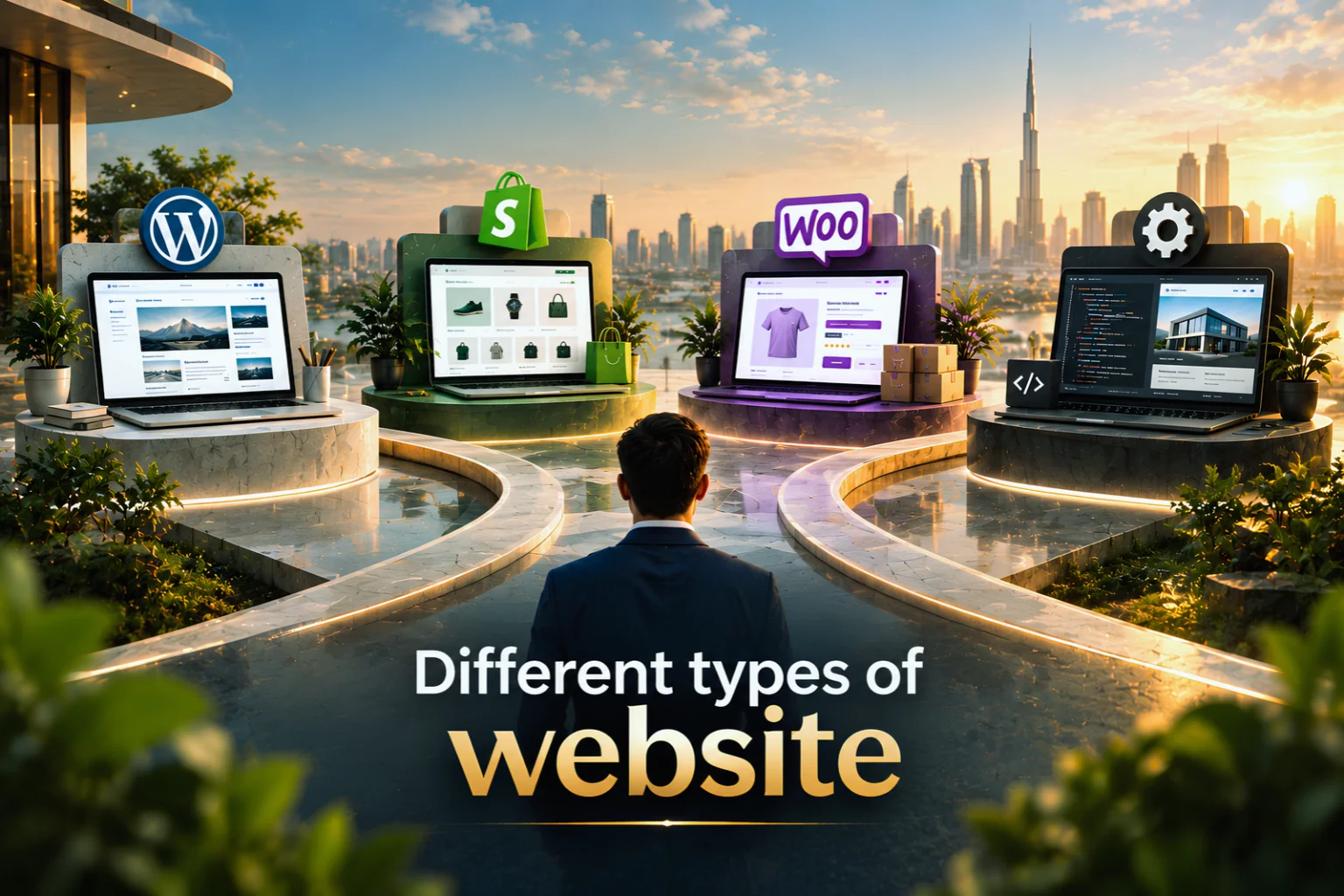
WordPress vs Shopify vs WooCommerce vs Custom Website: Quick Comparison
Short answerWordPress is the cheapest all-rounder, Shopify is the fastest way to start selling, WooCommerce sits between the two, and custom code is the most flexible and the most expensive.
| Feature | WordPress | Shopify | WooCommerce | Custom website |
|---|---|---|---|---|
| What it is | Free website software (a CMS) | Paid, hosted store builder | Free shop plugin for WordPress | Code written for your business |
| Best for | Business sites and blogs | New online stores | Stores that also publish a lot of content | Portals, B2B and unusual workflows |
| Monthly platform fee | None | From ₹1,499, billed yearly | None | None |
| Hosting | You arrange it | Included | You arrange it | You arrange it |
| Selling built in | No, add WooCommerce | Yes | Yes | Only what gets built |
| Design freedom | High | Medium, within themes | High | Complete |
| Who keeps it updated | You or your developer | Mostly Shopify | You or your developer | Your developer |
| Time to launch | Fast | Fastest | Medium | Slowest |
The row that surprises most people is the monthly fee. WordPress and WooCommerce don't have one, so their bills come from hosting and from whoever looks after the site.
What Are the Different Types of Websites?
Short answerYou can sort websites by the job they do (business site, online store, blog, portfolio, web app) or by how they're built (static HTML, a CMS, a hosted store builder or custom code).
Most of the confusion around this topic comes from mixing those two lists. "Ecommerce" is a job. WordPress, Shopify and Laravel are ways of building. An online store can run on Shopify, on WordPress with WooCommerce, or on custom code, and the same is true of a business site.
A CMS website (CMS stands for content management system) is one where you edit pages from a dashboard instead of in code. WordPress is the best-known CMS.
Static vs Dynamic Websites: What's the Difference?
A static website is a set of fixed files, and every visitor sees exactly the same page. A dynamic website builds each page from a database when someone opens it, which is how you get logins, carts, search and an admin panel.
Static sites are cheap to host, quick to load and hard to break. The catch is that every text change needs someone who can edit plain HTML. WordPress, Shopify, WooCommerce and nearly every custom build are dynamic.
WordPress and WooCommerce Are Not the Same Thing
WordPress is the website software. WooCommerce is a free plugin you install on WordPress to add products, a cart and a checkout. You can't run WooCommerce without WordPress, but plenty of WordPress sites never install it, and most business sites don't need to.
WordPress: The All-Rounder for Business Sites and Blogs
Short answerWordPress is free software that runs 39.6% of all websites. You pay for hosting, a theme and whoever keeps it updated.
It suits service businesses, clinics, schools, consultants and anyone who plans to publish posts regularly. Pages and posts sit in one dashboard, there's a plugin for nearly every job, and if you ever change agencies, almost any developer can pick the site up. The current version, as of October 2026, is 7.1.3.
The part people forget to budget for is upkeep. Plugins need updating, and each one is another thing that can break. Contact Form 7 was installed on 21 of the 27 WordPress sites in our portfolio check. It's a good plugin, but that's still 21 sites that need someone to update it.
WordPress is a poor fit if you want to sell hundreds of products and never think about a server, or if you need logins and bookings that no plugin handles well. When it is the right fit, our WordPress development team can build it and look after it for you.
Shopify: The Quickest Way to Start Selling Online
Short answerShopify is a paid store builder. For a monthly fee it takes care of hosting, security and checkout, so you can start selling within days.
Basic
₹1,499/mo
Billed yearly. ₹1,994 if you pay month to month.
2% on outside gateways
Grow
₹5,599/mo
Billed yearly. ₹7,447 month to month.
1% on outside gateways
Advanced
₹22,680/mo
Billed yearly. ₹30,164 month to month.
0.6% on outside gateways
Shopify India pricing, checked 21 October 2026. New stores were also being offered 3 months at ₹20 a month.
That gateway fee matters more in India than in most countries. Shopify Payments, Shopify's own payment system, isn't available here, so Indian stores take payments through gateways like Razorpay. On the Basic plan, Shopify then adds its 2% on top of Razorpay's own 2% + GST. On a ₹1,000 order, that's about ₹40 before GST.
Apps are the other running cost. Reviews, WhatsApp chat, COD rules and subscriptions usually come from apps, and many of them bill every month.
Then there's ownership: on Shopify, you rent the store. In a 29 September 2026 audit of a client's Shopify stores, one of them showed only "Store unavailable" on every page. Shopify shows that when a store is paused, usually over billing. The products, the pages and the checkout all went offline at once.
From our work · GIT Florist, Jaipur, October 2026
We set up GIT Florist, a Jaipur flower and cake shop, on Shopify and added 166 products over two days, 8 and 9 October 2026: 50 bouquets first, then 56 cakes, 20 chocolate boxes, 20 dry fruit boxes and 20 mithai boxes. Nobody had to touch a server.
If you'd like a store set up the same way, that's what our Shopify development service does.
WooCommerce: An Online Store Inside WordPress
Short answerWooCommerce is a free WordPress plugin that adds products, a cart and a checkout. The plugin costs nothing. Hosting, extensions and payment fees do.
What's free
- The WooCommerce plugin itself
- Cash on delivery, which is built in
- Razorpay's plugin for UPI, cards and netbanking
- Exporting your products and orders whenever you like
What costs money
- Hosting, about ₹3,000 to ₹8,000 a year for a small site
- Razorpay's 2% + GST on each payment
- Paid extensions, often with a yearly licence
- Someone to run updates and backups
- A better server once traffic grows
WooCommerce takes no cut of your sales on top of the gateway fee, and that's the main money reason sellers choose it over Shopify. The catch is that updates, backups and security are your job, or your developer's. If a plugin update breaks the checkout on a Sunday, nobody at WooCommerce is going to fix it for you.
Custom Websites: When Ready-Made Platforms Aren't Enough
Short answerA custom website is written for your business alone. It fits exactly, but it costs more, takes longer to build and ties you to the people who know the code.
Custom Business Websites vs Custom Ecommerce Websites
A custom business website is usually a portal of some kind: dealer logins, a quote builder, bookings with live availability, or a dashboard tied to your own data. Custom ecommerce is for stores that have outgrown plugins. Think price tiers for different B2B buyers, many sellers on one marketplace, or stock that has to match your ERP every few minutes.
We build these in frameworks like Laravel, and our ecommerce website development work covers custom stores as well as platform builds.
When a Custom Build Is Worth the Money, and When It Isn't
A custom build is worth it when you've already tried to bend WordPress or Shopify with plugins and the plugins have started fighting each other. It isn't worth it for a 5-page site, a normal shop, or a business that hasn't settled how it sells yet.
Custom code also has limits nobody warns you about, because someone made a choice early on and you live with it afterwards. Our own website is custom Laravel. In September 2026 a long blog post refused to save, because the database field behind our blog holds only 65,535 bytes. WordPress would never have hit that. If you're weighing the two routes, we've written about template vs bespoke websites as well.
Shopify vs WordPress: A Side-by-Side Comparison
Short answerShopify gets you selling faster with less upkeep. WordPress costs less over the years and gives you more control over content and SEO.
| Factor | Shopify | WordPress (WooCommerce for selling) | Why it matters |
|---|---|---|---|
| Getting started | Sign up, pick a theme, add products | Hosting, install, theme, then plugins | Shopify saves you the first week |
| Running cost | Plan from ₹1,499 a month, plus 2% on outside gateways | Hosting, about ₹250 to ₹670 a month | The gap grows as sales grow |
| SEO control | Good basics, but URLs always include /products/ or /collections/ | Full control of URLs, page structure and schema | Matters most for content-heavy sites |
| Blogging | Built in, fairly basic | The strongest of the four | If articles bring your customers, WordPress wins |
| Speed | Depends on the theme and apps | Depends on hosting, theme and plugins | Neither is fast by default |
| Updates and security | Shopify handles them | You or your developer | Shopify is less work |
| Ownership | You rent the store | You own the files and the database | Matters the day you want to switch |
Speed needs a closer look. Google treats a page as loading well when its main content shows up within 2.5 seconds. Four Shopify stores we audited on 29 September 2026 took between 4.7 and 14.5 seconds on mobile, with 420 to 615 KB of HTML on each page. Shopify's servers are quick. What you load on top of them decides the rest, and our notes on Shopify speed optimization cover the usual fixes.
From our work · Dekulture, Jaipur, September 2026
Dekulture uses both platforms. Each of its five craft brands has a WordPress site (.store) for export buyers who ask for bulk quotes, and a Shopify shop (.shop) for retail customers who pay by card or Razorpay in rupees.
The export side needs long product pages and enquiry forms, which WordPress handles well. The retail side needs a checkout that simply works, and that's where Shopify is strongest.
Shopify vs WooCommerce: Which Is Better for an Online Store in India?
Short answerFor a new seller, Shopify is simpler. WooCommerce gets cheaper as sales grow, and it's the natural choice if your site already runs on WordPress.
Setup and daily work. Shopify's admin looks the same in every store, so new staff learn it quickly and there's little to break. WooCommerce runs inside the WordPress dashboard, which is handy if you already blog there, but it has more settings and more plugins to keep in step.
Payments. Both take UPI, cards and netbanking through gateways like Razorpay, and both let you offer cash on delivery. The real difference is Shopify's extra 2% on Basic, which Indian stores pay because Shopify Payments isn't offered here. At ₹75,000 a month in online sales, that 2% comes to ₹1,500, which is more than the Basic plan itself.
Apps vs plugins. Shopify apps mostly charge monthly. WooCommerce extensions are often a yearly licence, and free plugins cover a lot of the basics. On both, every add-on slows the store down a little, so install only the few you actually use.
How Much Each Type of Website Costs in India in 2027
Short answerThe build price is the smaller part. Hosting, platform fees and payment charges over three years decide which option is really the cheapest.
Build Cost
A 5-page business site with us starts at ₹15,000. Online stores and custom builds vary a lot more, depending on how many products, features and integrations you need, and our guide to ecommerce website cost in India breaks those prices down.
Running Costs: Hosting, Domain, Apps and Fees
A typical business website costs ₹5,000 to ₹12,000 a year to keep online: ₹800 to ₹1,500 for the domain, ₹3,000 to ₹8,000 for hosting and about ₹1,500 for each business email user. Our website development cost guide goes through each of these. On Shopify, the plan replaces the hosting bill. Every online store also pays a gateway fee, and Razorpay's standard rate is 2% + GST on each successful payment.
First-Year vs Three-Year Cost
Take a small store selling ₹50,000 a month online, which is ₹6 lakh a year. The table below leaves out the build price, the domain and Razorpay's 2%, because those cost the same on every option. What's left is what the platform itself costs you:
| Option | Year 1 | 3 years | Not included |
|---|---|---|---|
| Shopify Basic, billed yearly | ₹29,988 | ₹89,964 | Paid apps |
| Shopify Grow, billed yearly | ₹73,188 | ₹2,19,564 | Paid apps |
| WooCommerce on ₹8,000 hosting | ₹8,000 | ₹24,000 | Paid extensions, update work |
Shopify Basic works out to ₹17,988 for the plan plus ₹12,000 in fees each year. Below about ₹75,000 a month in sales the plan is the bigger cost, and above that the fee is. WooCommerce only looks this cheap if someone is keeping it updated, so add that help to its row before you compare.
Which Website Should You Pick for Your Business?
Short answerPick by how your business makes money, not by which platform is most popular.
- Bloggers and content creators: WordPress. Writing is what it does best, and every post stays yours.
- Local service businesses such as clinics, coaching centres and contractors: WordPress, or a static site if your pages rarely change. Most of your leads will come by phone and WhatsApp, not through a cart.
- A new online store: Shopify Basic. You can be selling within a week and move later if you outgrow it.
- A growing brand that publishes a lot: WooCommerce, once Shopify's fees and app bills cost more than better hosting and a developer would.
- Complex needs like B2B pricing, a marketplace or ERP sync: custom. Get the scope in writing first, and make sure the code and the server are registered in your name.
Frequently Asked Questions
Is Shopify better than WordPress?
For selling products with little technical work, yes. For blogs and service websites, WordPress is the better tool, which is part of why it runs 39.6% of all websites against Shopify's 5.3%.
Is WooCommerce really free?
The plugin is. A working store still pays for hosting (roughly ₹3,000 to ₹8,000 a year for a small site), a gateway fee of about 2% + GST per payment, and any paid extensions it uses.
Which type of website is cheapest in India?
A static site or a simple WordPress site. Keeping one online can cost as little as ₹5,000 a year for the domain, hosting and email, and a 5-page site with us starts at ₹15,000 to build.
Shopify or WordPress, which is better for SEO?
Both can rank well. WordPress gives you more control, because Shopify always adds /products/ or /collections/ to its URLs, and it's the stronger blogging tool. Your content and page speed matter far more than the platform.
Can you move from Shopify to WordPress later?
Yes. Products and customers export from Shopify as CSV files and import into WooCommerce. The theme and apps don't come with you, and every old URL needs a 301 redirect, so a 200-product store needs at least 200 redirects for the products alone.
Static or dynamic, which is better for a small business?
If your 5 or 6 pages barely change, a static site is cheaper and quicker. If you'll update offers, add posts or take bookings, go dynamic with a CMS such as WordPress.
Is a custom website better for SEO?
Not on its own. Google doesn't rank sites by platform, and a custom site still has to show its main content within 2.5 seconds and be easy to crawl. Custom code only helps when you need SEO features a CMS can't give you.
Can you accept UPI and cash on delivery on Shopify and WooCommerce?
Yes, on both. UPI comes through a gateway like Razorpay, and both platforms let you switch on cash on delivery. On Shopify Basic, orders paid through the gateway carry Shopify's extra 2% fee.
Can you switch platforms without losing Google rankings?
Mostly, yes, if every old URL redirects to its matching new page and your titles and content stay the same. A dip for a few weeks is common. Drops that last for months usually come from missed redirects.
Sources: W3Techs, CMS usage statistics; Shopify India pricing; Shopify Payments supported countries; Razorpay pricing; WooCommerce on WordPress.org; WordPress download page (version 7.1.3); Core Web Vitals thresholds.