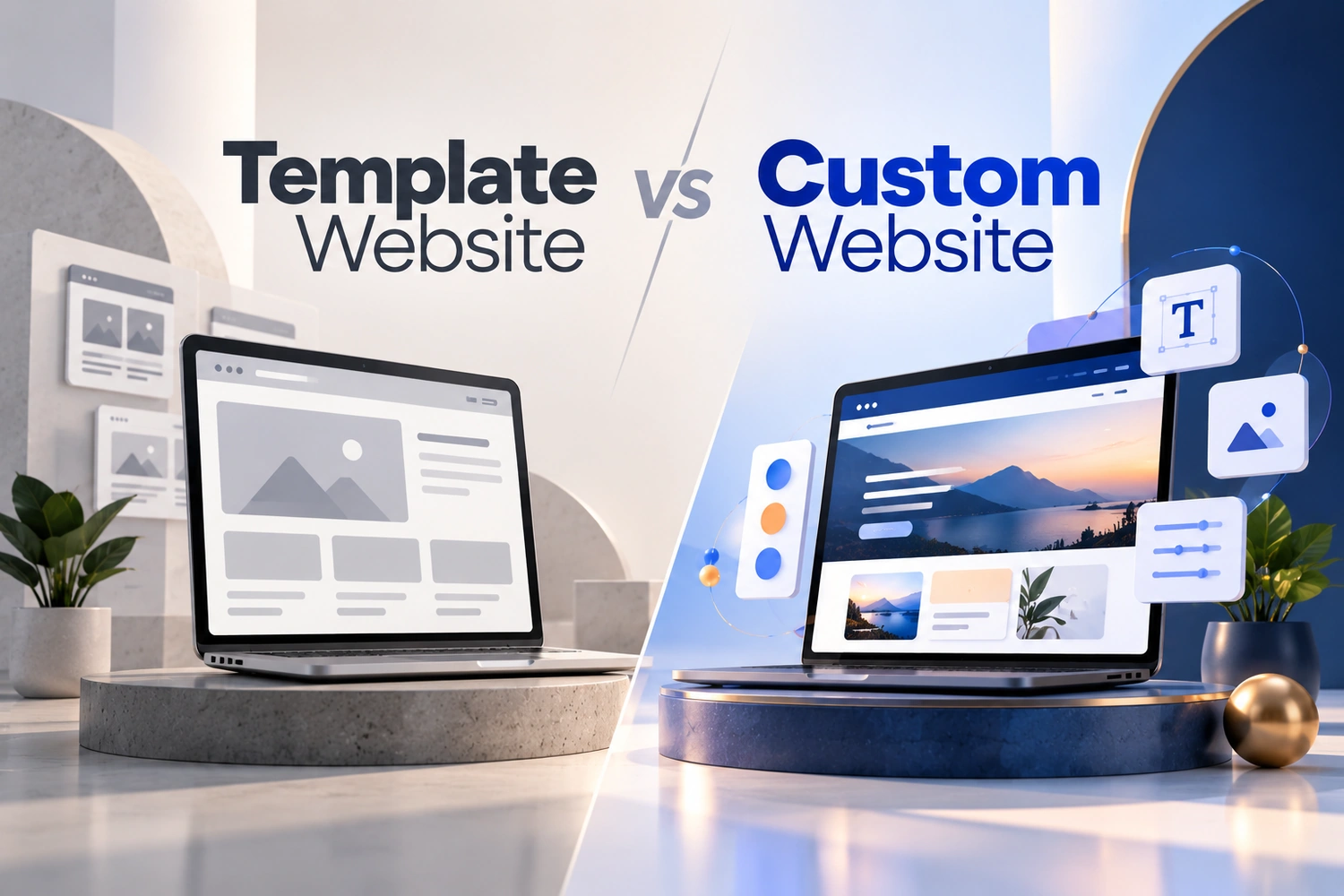
Nearly every website enquiry we get reaches the same question sooner or later. Should we buy a ready-made template and fill it in, or have something designed from scratch? The answer changes the price, the launch date and how easy the site is to change two years from now.
In India, a WordPress site built on a good theme usually costs ₹20,000 to ₹60,000, and the theme itself is a one-time ₹3,000 to ₹10,000. A custom WordPress design costs ₹50,000 to ₹1,50,000, and a site written in custom code starts at around ₹1,50,000. A template site can go live in one to three weeks. A custom design usually takes four to eight weeks.
In this guide, we compare the two on cost, speed, SEO, security and ownership, explain the middle option a lot of businesses end up with, and say which we'd pick for different kinds of business.
What Is a Template Website?
Short answerA template website is built on a ready-made design, usually called a theme, that many other sites also use. You add your logo, text and photos, and change colours and layouts within whatever limits the theme allows.
Templates come in a few forms: WordPress themes, Shopify themes, drag-and-drop builders like Wix and Squarespace, and plain HTML templates built on frameworks like Bootstrap. WordPress alone runs 40.2% of all websites, according to W3Techs on 2 October 2026, and most of those sites use a theme someone else designed.
Popular themes sell in huge numbers. Avada, the best-selling theme on ThemeForest, had passed 1 million sales by the start of 2025. That's a lot of businesses starting from the same layout.
What Is a Custom (Bespoke) Website?
Short answerA custom website is designed for your business first and then built to match that design, so its layout and features exist only on your site.
Bespoke is the British word for the same thing. It's what our clients in the UK say, where we also work as a web design agency in London. In India nearly everyone says custom.
Custom doesn't have to mean every line of code is written from zero. Usually a designer lays out the pages in a tool like Figma, you approve them, and a developer builds them on WordPress, Shopify or a framework like Laravel. What makes it custom is that the design came first and the code was written to match it.
NoteAsk what "custom" means in any quote you get. Some agencies call a template in your brand colours a custom website. Ask to see the page designs before any code is written. If there aren't any, you're buying a template.
Template vs Custom Website: Side by Side
Here's how the two compare for a typical small or mid-sized business website in India.
| What you're comparing | Template | Custom |
|---|---|---|
| Upfront cost | ₹15,000 to ₹60,000 | ₹50,000 to ₹1,50,000 on WordPress, ₹1,50,000 and up in custom code |
| Time to launch | 1 to 3 weeks | 4 to 8 weeks, or 2 to 6 months for a web app |
| Design | Shared with everyone who bought the theme | Yours alone |
| Features | Whatever the theme and its plugins offer | Whatever you pay to have built |
| Page speed | Often heavy, with code for features you don't use | As light as your developer makes it |
| Yearly costs | Hosting plus theme and plugin renewals, about ₹4,000 to ₹25,000 on WordPress | Hosting plus a developer for changes, ₹10,000 to ₹1,00,000 on custom code |
| Big changes later | Easy inside the theme's options, hard outside them | Easy if the code is clean and documented |
The upfront gap is smaller than it looks. A template that needs five paid plugins and regular developer fixes to bend it into shape can cost as much as a simple custom design by its second year.
When a Template Is the Right Choice
A template is the right call when speed and budget matter more than looking different, which is true for most new businesses. It usually makes sense if:
- You're new and want to test the business before spending more on it.
- The site is a brochure: 5 to 10 pages, a contact form and a WhatsApp button.
- Your budget is under about ₹30,000.
- You need to be live within a month, for a launch, an exhibition or a funding pitch.
- You're selling products and the platform does the heavy lifting. A good Shopify theme handles checkout, payments and stock better than most custom builds at that price.
Plenty of businesses start here, and that's fine. A clean template with real photos and clear prices does more for you than an expensive custom site with nothing useful on it.
When a Custom Website Is Worth It
Custom is worth paying for when the website is how you win customers, not just the place they check that you exist. That's usually the case if:
- Most of your enquiries or orders come through the site.
- You need something no plugin does well, like a booking flow tied to staff calendars, a price calculator or a dealer login.
- Your brand depends on looking different, as it does in luxury, interiors, architecture and fashion.
- You run Google Ads or SEO seriously, where a fast, light page makes a measurable difference.
- You've outgrown a template: plugins clash, updates break things, and you pay a developer every month to patch it.
- Your team wants to keep editing in WordPress, but on a theme built only for you. Good WordPress development gives you both.
The Downsides of Templates Nobody Mentions
Templates are cheap to start with, but they bring five costs that rarely show up in the quote.
Your site can look like a competitor's
A theme that has sold a million copies will turn up on other sites in your city, sometimes in your own trade. Free stock photos do the same, because the same images appear on thousands of other sites. Templates also date quickly as web design trends move on, and refreshing a theme you don't control is harder than it sounds.
Extra code slows the page down
Big themes ship code for every layout in their demo, whether you use it or not. Google's target for Largest Contentful Paint, the time it takes the main content of a page to show, is 2.5 seconds or less.
When we audited five Shopify stores in our portfolio on 29 September 2026, the HTML alone weighed 420 to 615 KB per page, and the main content took 4.7 to 14.5 seconds to appear on mobile. A theme is rarely the only cause of numbers like that, because images and apps add plenty, but it's where we start looking. Our notes on Shopify speed optimization and on how to optimize WordPress for faster loading cover the fixes.
Plugins carry most of the security risk
Patchstack counted 11,334 new security flaws across WordPress in 2025. 91% were in plugins, 9% were in themes and only 6 were in WordPress itself. It also found that about half of the high-impact ones are exploited within 24 hours of becoming public. Every plugin a template depends on is one more thing to keep updated.
What to do: use as few plugins as you can, update them weekly, and never install a "nulled" (pirated) theme. They're sold cheaply online and often come with malware built in.
You pay for it again every year
Premium theme licences and paid plugins renew every year if you want updates, at ₹2,000 to ₹15,000 a year for each paid plugin. Skip a renewal and you stop getting security fixes.
Copies keep things you didn't mean to keep
Templates and cloned sites carry leftovers: demo text, old page titles, settings with someone else's name still in them. Here's a real one.
From our client work · Dekulture, Jaipur
In September 2026 we wrote the content for four new export stores for Dekulture: Feltora, Gardenalia, Jemfyrd and Notera. All four were page-for-page copies of the group's first store, Lume Loam, on the same WordPress theme. It was a sensible decision. One build served five brands, and each new store only needed its own words, products and settings.
The copying also carried over things nobody meant to keep. Every page title on the new stores still ended in "Lume Loam" until we replaced them on 24 September. When I checked the four home pages again on 2 October 2026, the schema (the hidden business details search engines read) still named Lume Loam as the business on all four. It's a quick change in the SEO plugin's settings, but only if someone knows to look.
Is There a Middle Option?
Yes. A custom design for the pages that sell, built on a platform you can edit yourself, is what we suggest to most small and mid-sized businesses.
In practice, your home page, service or product pages and enquiry form are designed for you, while the blog, policy pages and admin panel use the platform's standard parts. You get a site that looks like yours and still runs as a CMS website your team can update without calling a developer.
Price-wise it sits in between. As a rough guide, a single landing page costs ₹8,000 to ₹15,000 on a template and ₹15,000 to ₹40,000 with a custom design, and a full site built this way usually lands at the lower end of the ₹50,000 to ₹1,50,000 custom WordPress range.
Which One Should You Pick?
These are the calls we'd make for the kinds of business that ask us most often.
A clinic, CA firm or consultant
Start with a template
Visitors want your services, fees, timings, location and reviews. A clean template with real photos covers that. Spend what you save on photos and reviews for your Google Business Profile.
A store with under 50 products
Use a Shopify or WooCommerce theme
Checkout and payments are where custom builds get expensive, and both platforms already do them well. Budget ₹50,000 to ₹1,50,000 for a basic store on a ready theme. Our guide to ecommerce website cost in India breaks it down.
A manufacturer or exporter
Go for the middle option
Buyers abroad judge you by your website long before they ask for a sample. A custom home page and product range pages, on a platform your team can update, is usually enough.
Bookings, logins or calculators
Build it custom
When the site has to do a job, like taking a booking, showing a dealer their prices or working out a quote, templates and plugins start fighting you. It's cheaper to build it properly once.
Can You Switch From a Template to Custom Later?
Yes, and many businesses do once the site starts bringing in work. Most of the risk sits in the move itself: old links, image paths and redirects. Before you switch:
- Keep the same page addresses where you can, or set up 301 redirects from every old URL to its new one.
- Check that images and files don't still point at the old site's folders.
- Move your blog posts with their titles and meta descriptions, not just the text.
- Save your Search Console data and current rankings before launch, so you can spot a drop early.
From our client work · Colours India Tours, Jaipur
Colours India Tours, a Jaipur tour operator, had already moved off WordPress by the time we audited the site in August 2026. The writing on the new site is strong. But nine images were still pointing at /wp-content/ folders from the old WordPress install, so they showed as broken, and four URLs in the sitemap redirected, three of them with a temporary 302 instead of a permanent 301.
None of it is hard to fix. It's just much easier to catch before launch day than after. If you're planning a move like this, our website redesign page explains how we handle it.
Do It Yourself or Hire a Designer?
If your budget is small and your needs are simple, building a template site yourself is a fair choice. Wix, WordPress.com or a Shopify trial can get a basic site up over two or three weekends. Shopify's Basic plan in India is ₹1,499 a month paid yearly. The cost is mostly your time, and the result is usually fine for a first year.
Hiring help makes sense when:
- The site has to bring in enquiries from day one, from ads or from Google.
- You need more than the template does and don't want to learn code.
- You'd rather spend those weekends running the business.
- You want one person to call when something breaks.
If you hire, ask the right questions first. Our list of factors to consider when working with a website designing company covers them. For fair prices by type of site, see our guide to website development cost in India. At GIT Infosys, a 5-page website costs ₹15,000 and a fully custom website ₹55,000.
Common Mistakes When Choosing
- Choosing a theme from its demo. The demo looks good because of professional photos and short, polished copy. With your phone photos and three paragraphs of text, it will look different.
- Buying the theme before writing the content. Write your pages first, then pick a design that fits them.
- Paying for "custom" and getting a template. Ask for the page designs before development starts.
- Letting the developer register your domain. Make sure the domain, hosting and admin logins are all in your name. Owners get locked out of their own sites this way more often than you'd think.
- Putting a heavy theme on the cheapest hosting. A shared plan at a few hundred rupees a month struggles with a theme built around sliders and animations.
- Not checking the demo on your own phone. Most of your visitors will see the site there first, so that's where it has to work.
Frequently Asked Questions
What is the difference between a template and a custom website?
A template website uses a ready-made design that other sites share, and you fill in your content. A custom website is designed for your business first and built to match. In India, template sites cost about ₹15,000 to ₹60,000, and custom designs start around ₹50,000.
Is a custom website better for SEO?
Not automatically. Google ranks pages, not build methods, so a fast template with useful content can beat a slow custom site. Custom helps when a heavy theme keeps your main content from loading within Google's 2.5-second target.
How much does a custom website cost in India?
A custom WordPress design costs about ₹50,000 to ₹1,50,000, and a site in custom code starts at around ₹1,50,000. At GIT Infosys, a fully custom website costs ₹55,000.
What does bespoke website mean?
Bespoke is the British word for custom. A bespoke website is designed and built for one business instead of being adapted from a template. You'll mostly hear the word in the UK, while in India people usually say custom.
Can you customise a website template?
Yes, within limits. Colours, fonts and the layouts the theme offers are easy to change. Anything beyond that needs a developer, at roughly ₹5,000 to ₹50,000 per feature.
How long does it take to build a custom website?
Four to eight weeks for a typical business website, including design approval. A custom web app with logins or bookings takes 2 to 6 months.
Is WordPress a template or a custom website?
Neither. WordPress is a platform, and you can run it with a ready-made theme or with one designed only for you. It powers 40.2% of all websites.
Should a small business use a website template?
Usually yes, at first. If your budget is under about ₹30,000 or you need to launch within a month, a good template is the sensible choice. Move to custom once the site starts bringing in work.
Sources: W3Techs, WordPress usage; Envato, Avada hits 1 million sales; Patchstack, State of WordPress Security in 2026; Google Search Central on Core Web Vitals. Prices are from our own website development cost guide, October 2026. Client data from our audits of 21 August, 29 September and 2 October 2026.