OpenAI turned on ChatGPT Ads in India on 27 August 2026. More than fifty brands went live inside that first week, and from 4 September any Indian business can open the self-serve Ads Manager and buy the placement themselves.
We buy paid media for Indian businesses out of Jaipur, and the questions started the morning the news broke. What does it cost. Can we target one city. Does the pixel survive a WhatsApp handoff. This guide answers those, roughly in that order: account creation, campaign structure, context hints, budgets, bidding, the pixel, ad review, and the first thirty days. Rupee numbers throughout, India rules throughout.
What this guide covers
The India launch, in dates
Short section. The facts are short.
There are two ways in right now. Until 4 September you go through OpenAI's ads solutions team or through an agency partner, and WPP and Omnicom were named first on a non-exclusive basis, meaning more agencies will follow. After 4 September you can just log in and build it yourself.
How many ChatGPT users India has
This is the number that decides whether the channel is worth your time, so let's get it right.
India crossed 100 million weekly active ChatGPT users as of February 2026. That makes it the second-largest market in the world behind the United States, out of roughly 800 million weekly users globally. Roughly one in every eight ChatGPT users is Indian. OpenAI says weekly actives here doubled year on year, and other counts put the growth across the previous year closer to fourfold.
India also has the largest student population on ChatGPT of any country. Hold onto that, because it shapes who you're actually buying. I'd treat it as the single most important line in this section: reach numbers that look extraordinary on a slide can still hide the fact that a large share of the people behind them are years away from a purchase in your category, and no amount of budget fixes that.
One more piece of context that most write-ups have skipped, and it's the reason I wrote a separate piece on whether ChatGPT advertising deserves your budget at all. ChatGPT Go, normally ₹399 a month, has been free in India for twelve months since 4 November 2025. Ads serve to Free and Go users. So the ad-eligible audience in India is unusually large, and a big share of that audience has never paid OpenAI a rupee. Great for reach. Something to remember when you're reading your conversion rate.
Who your ads can reach
Half of India's ChatGPT users are off limits to you. Here's the split.
| Plan | Price in India | Sees ads? |
|---|---|---|
| Free | ₹0 | Yes, logged-in adults |
| Go | ₹399/month | Yes, logged-in adults |
| Plus | Paid | No |
| Pro | Paid | No |
| Business | Paid | No |
| Enterprise | Paid | No |
| Education | Paid | No |
Three hard exclusions on top of that. Accounts that indicate the user is under 18 get no ads at all. Logged-out users get no ads. And ads don't run against health, mental health or political conversations.
The paid-tier exclusion is worth sitting with for a second. Every ChatGPT Plus and Pro subscriber in India is unreachable through this channel. If your customer is the sort of person who pays for the good version of everything, a chunk of your market sits behind a wall you can't buy through, and I haven't seen a single launch write-up mention it, which tells you how little anyone has thought about who is actually on the other side of these impressions.
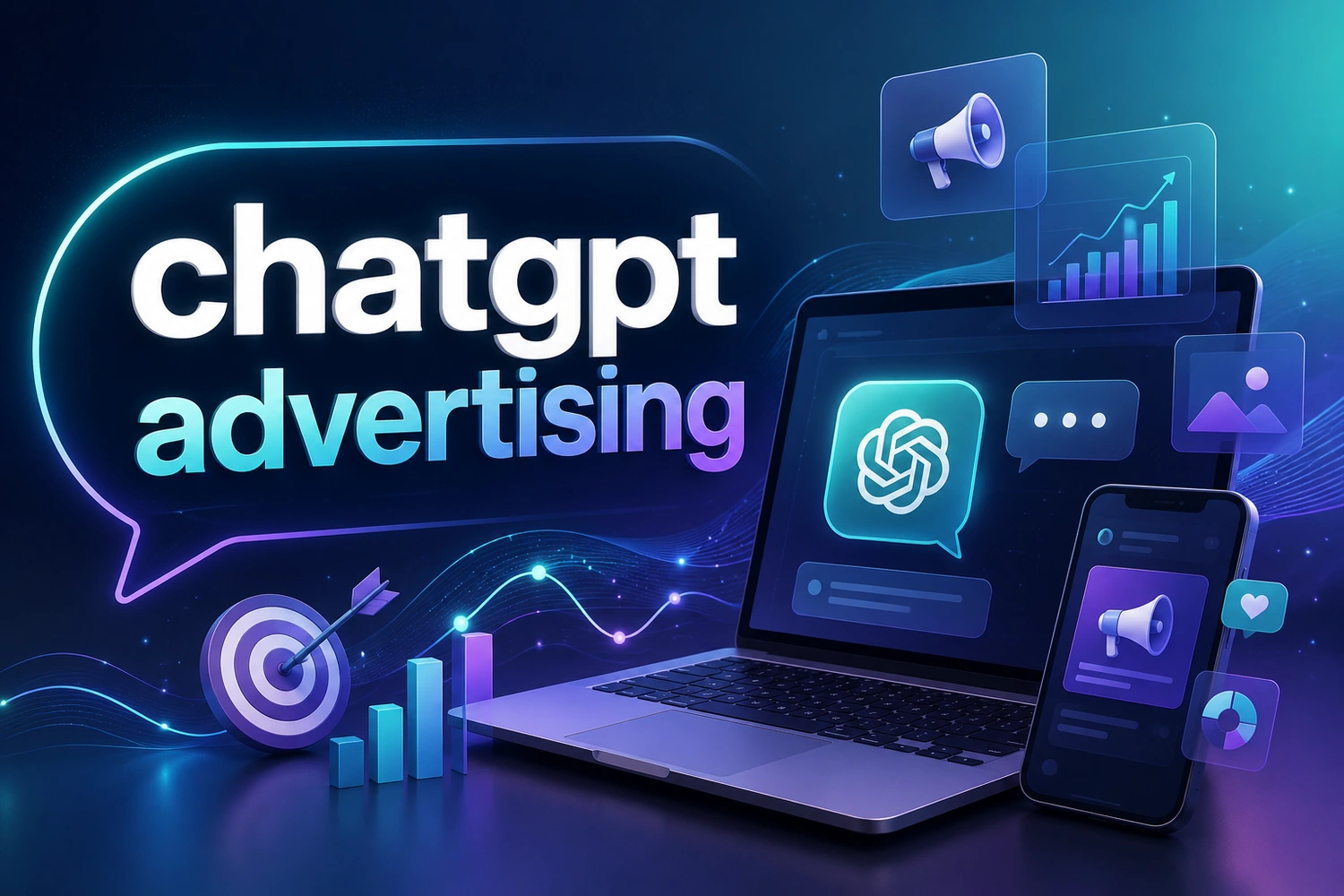
What a ChatGPT ad looks like
A card. It sits below ChatGPT's answer, in its own visually separated block, labelled as sponsored. Never inside the answer text itself.
Under the hood you get a favicon, a short headline, a line of description, an image and a click destination. Closer to a compact Google search ad than to a Meta creative, and much tighter on characters than either.
Buying ads doesn't change what ChatGPT recommends in the organic answer above. You're renting the space underneath, nothing more.
Step 1: open the ads account
Go to ads.openai.com and sign in with your existing OpenAI account, or make one with a work email. Four things to complete before you can build anything.
Business details
Legal company name, website URL, industry from a dropdown, brand name and a logo or favicon. The favicon renders small, around 32 by 32, so a detailed logo turns into a smudge. Use the mark, not the full lockup with your tagline.
Account settings
Country, currency and timezone. Read this twice: these lock once you confirm them. I'd set currency to INR and timezone to IST at the start, because unpicking it later means a support ticket. Account ownership is also fixed at this stage and changing that person needs OpenAI support too, so put it in the name of someone who will still be at the company next year.
Identity verification
OpenAI runs manual verification, with identity checks handled through Persona in some markets. Budget a few business days for this. Do it in the last week of August, not on the morning you want to launch. I'd start it today.
Billing
Business name, address, invoice email, and a card. Visa, Mastercard and Amex are accepted. You can set a monthly spending cap here and I'd suggest you do, at least for the first month.
Team invites come next. Three roles, which is fewer than Google gives you but enough: Admin with full access, Campaign Manager to build and edit, Viewer for read-only. Your accountant gets Viewer. I'd give no agency Admin in month one, ours included.
One account per business, owned by one person. There's no Manager or MCC structure like Google Ads has, so agencies handling several Indian clients are stitching this together account by account for now.
Step 2: campaign structure
Three levels, and if you've built a Google Ads account you already know the shape.
Campaign holds the objective, the daily budget and the schedule. Ad group holds the targeting, which here means context hints. The ad itself carries the creative and the landing page.
Account ceilings are generous. Five thousand campaigns, five thousand ad groups, five thousand ads. Nobody is running out.
Naming convention, since nobody does this and everybody regrets it: Brand-Objective-Audience-Month. Three months in, comparing eleven ad groups in a spreadsheet, you'll be glad you did.
The objective is set at campaign level and it locks after creation. Choose wrong and you rebuild the campaign. Views buys on CPM, Clicks buys on CPC, and there's now a conversion-optimised objective, oCPC, which started in beta on product feed campaigns in August.
Step 3: writing context hints
Forget everything you know about match types.
No keywords. None. This is the single biggest adjustment for anyone coming off Google Ads, and it's where most first campaigns fall over.
A context hint is a natural-language description of the conversation you want to appear beside. ChatGPT reads what the person is actually discussing, across multiple turns, and decides whether your card belongs there. So you're writing a brief, not a match list.
CRM, best CRM, CRM software India, affordable CRMA founder of a 15-person services company in India comparing CRM tools for a small sales team, worried about GST invoicing and WhatsApp follow-ups, budget under ₹50,000 a year. Not enterprise buyers, not students researching for coursework.A working hint describes four things. Who is talking, what they are trying to do, what constrains them, and who you want to exclude. That's the format. Guidance floating around suggests a 280-character ceiling per hint, and most practitioners run five to ten hints per ad group, clustered tightly around a single intent. Confirm the exact limit in the interface, since it has moved once already.
Three rules that hold up:
- One intent per ad group. If you're describing two different buyers, that's two ad groups.
- Specific beats broad. "People who want marketing help" wastes money in a way that's genuinely painful to watch.
- Write the disqualifier. I'd write it first, honestly. Students, job seekers and people doing research are the three biggest budget leaks in India specifically, given who's on the free tier.
Negative keyword capacity has been reported at around 25 entries where it's available, so treat exclusion as something you design up front rather than bolt on in week three.
Step 4: the creative
Tight. Much tighter than Google or Meta, and I think this is the part most Indian agencies will underestimate, because a headline that works at 90 characters in a Google RSA has to survive being cut to roughly a quarter of that here without turning into a slogan nobody understands.
| Asset | Reported spec | Practical advice |
|---|---|---|
| Headline | Sources disagree, roughly 16 to 50 characters | I'd write to 24 and it renders everywhere |
| Description | Roughly 32 to 100 characters | One benefit. Not three |
| Image | 256×256 minimum, 512×512 better, square, PNG or JPG | Product on plain background beats a lifestyle shot at this size |
| Favicon | Account level, 64×64 or better | Your mark, not your logo with text |
| Landing page | Valid HTTPS, must match the advertised product | Generic homepages get rejected at review |
| Variants | 3 to 5 per ad group | Different angles, not different adjectives |
Published character limits vary between guides and OpenAI has changed them at least once, so confirm the live numbers in Ads Manager before your designer builds forty assets to the wrong spec.
Every landing page URL gets tagged. utm_source=chatgpt&utm_medium=cpc&utm_campaign=your-campaign. Do it at build time. Retrofitting UTMs after two weeks of spend means two weeks of unattributable traffic sitting in your analytics as direct.
On the landing page rule, take it seriously. Sending ChatGPT traffic to your homepage is the most common rejection reason going, and even when it slips past review it converts badly. Somebody clicked because they were mid-conversation about one specific problem. Land them on that problem.
Targeting options in India
Here's the honest picture, and there's a gap in it that matters for a lot of Indian businesses.
| Lever | Status |
|---|---|
| Context hints | Yes, your main control |
| Country targeting | Yes |
| Sub-country geo (state, city, pincode) | Built for US state, DMA and ZIP since 22 May. India equivalents not confirmed at launch |
| Platform | Yes, iOS app, Android app and web, added August |
| Custom audiences from email or phone lists | Running in the US since spring, availability in India to confirm at signup |
| Demographics | Thin |
| Lookalikes | No |
| Site retargeting | No |
| Dayparting | Not exposed |
Read that geo row again if you run a local business. Geographic targeting was built as US state, DMA and ZIP. Whether Indian states or cities are selectable from day one is the first thing I'll be checking when accounts open on 4 September, and to me it decides whether a Jaipur clinic or a Pune coaching centre belongs in this auction at all. National CPMs to reach people who can't walk into your shop is not a strategy, it's a donation.
Location signals come from a mix of account-level data, device-inferred location and conversational context, which is a softer instrument than Google's radius targeting. If you need a five-kilometre ring, this platform doesn't have one yet.
Budget: ₹725 and what to actually spend
₹725 a day is the floor. It's ₹21,750 a month. Not a test budget, and I want to be blunt about why, because I expect plenty of Indian businesses to open an account on 4 September, put the minimum in, watch almost nothing happen for three weeks and conclude the platform is broken, when what actually failed was the arithmetic.
Indian auction prices don't exist yet, so the only benchmarks anyone has are US and European ones. Agency round-ups this month put ChatGPT CPMs at $25 to $45 after early inventory pressure eased, with clicks at $3 to $5 in general categories and $8 to $18 in software and finance. Reach campaigns carry a default max bid around $60 CPM. Convert at roughly ninety rupees to the dollar:
| Benchmark | In rupees (approx) | ₹725/day buys |
|---|---|---|
| $30 CPM | ₹2,700 per 1,000 impressions | about 270 impressions a day |
| $45 CPM | ₹4,050 per 1,000 | under 200 impressions a day |
| $3.30 CPC | ₹300 per click | roughly 2 clicks a day |
| $10 CPC | ₹900 per click | under 1 click a day |
Those rupee figures are US and European benchmarks converted at an assumed rate, not observed Indian prices. No Indian auction data exists before 4 September 2026. Use the table as an order-of-magnitude check on your budget, never as a rate card.
Two clicks a day. Sixty clicks a month. At a healthy 5% conversion rate that's three leads, which tells you nothing you can act on.
Now, Indian clearing prices will almost certainly land below American ones. They always do. A mature auction here looks nothing like that: Google Ads in India clears anywhere from ₹3 to ₹460 a click depending on the vertical. Meta CPMs in India run at a fraction of US CPMs and the same gravity should apply here, especially while the auction holds dozens of advertisers rather than tens of thousands. But nobody knows the number until the auction opens, and anyone quoting you an Indian ChatGPT CPM today is reading American blogs out loud.
There is one Indian reference point that does exist, though, and it's worth holding the converted numbers against it. Google Ads in India clears roughly ₹3 to ₹460 a click depending on the industry, and most small businesses run ₹15,000 to ₹60,000 a month in media before the 18% GST. Set that beside a converted ChatGPT benchmark of ₹270 to ₹450 a click and you can see the problem: on today's US prices, a ChatGPT click would sit near the top of the Indian Google range, in an auction with no local benchmarks and no city targeting. Our Google Ads cost in India breakdown has the full vertical-by-vertical table.
My planning band for a first Indian test, labelled as a planning band and not a quotation:
| Tier | Daily | Three weeks | What it gets you |
|---|---|---|---|
| Platform floor | ₹725 | ₹15,225 | An anecdote |
| Minimum useful test | ₹3,000 | ₹63,000 | Enough clicks to judge creative |
| Comfortable test | ₹5,000 | ₹1,05,000 | Enough conversions to judge the channel |
| Scaling, after it works | ₹10,000+ | ₹2,10,000+ | Only after you've seen a working CPA |
US guidance suggests $50 to $100 a day as a practical floor and $100 to $300 for a real two-week read, which is ₹4,500 to ₹27,000 a day. I think that's high for India and I'd start at ₹3,000. If costs come in as low as I expect, you'll get a cleaner read for less money than any American case study implies.
CPC, CPM and oCPC
Clicks (CPC). You pay per click. Recommended opening bids sit around $3 to $5, so roughly ₹270 to ₹450, though Indian bids should settle lower. I'd start here. Almost every new advertiser should.
Views (CPM). You pay per thousand impressions, with a default maximum bid around $60. Use it for awareness when you already know your creative works. Not for a first campaign. In my view a CPM buy rarely teaches you anything a CPC buy wouldn't have taught you cheaper.
oCPC. The conversion-optimised objective, in beta since August and first available on product feed campaigns. It needs conversion history to be worth anything.
OpenAI made "maximize results" the default bid strategy for eligible new ad groups in August. Turn it off on day one. Automated bidding on a fresh account, in a fresh country, with no conversion data behind it, is an expensive way to discover what the algorithm guesses. Run manual CPC for two weeks, feed the pixel real events, then let it take over.
Conversion tracking setup
Do this before you build a single campaign. Not after. Our rule at GIT Infosys is short: no validated tracking, no launch, however much anyone wants to see spend that week.
The pixel
A JavaScript pixel through the OAIQ SDK. It drops a first-party __oppref cookie with a 30-day life and hashes match data in the browser using SHA-256. Automatic advanced matching has been switched on by default for existing web pixels since 17 August. Install it on the landing page and on every conversion page: signup, thank-you, order confirmation. OpenAI owns the pixel, so you can't generate one independently the way you might with a self-hosted tag.
Pixel validation diagnostics arrived in August and they now tell you which field failed and why, which is a genuine improvement on guessing.
The Conversions API
Server-to-server events with deduplication through shared event IDs. It accepts web, app, offline, in-store, phone and email events. There are no native CRM or CDP connectors yet, though Hightouch, Triple Whale and WorkMagic integrations exist.
Run both. Browser-only tracking loses events to ad blockers, iOS privacy settings and app-to-browser handoffs, and my rough estimate is that most Indian advertisers running browser-only are under-counting by a fifth to a third.
The four things that break Indian funnels
WhatsApp. Person clicks your ad, lands, taps the green button, and vanishes from your analytics. Fire a Lead event on the WhatsApp click itself, treat it as a proxy, and discount it against your real chat-to-close rate. If forty of a hundred openers reply and a quarter of those buy, your true conversion is a tenth of the dashboard number. Write that multiplier down before you launch.
Phone calls. A tel: link is invisible. Use call tracking numbers and push answered calls back through the Conversions API as offline events.
UPI redirects. That hop out to a payment app and back has broken thank-you-page events on every platform I've worked with. Confirm purchases server-side from your order webhook. Card checkouts are usually fine; it's the UPI intent flow that drops people.
Cash on delivery. If a fifth of your COD orders come back as RTO, your ROAS is fiction until you push returns back in as negatives.
Ad review and approval
Two separate waits, and people conflate them constantly. It's worth knowing which one you're stuck in.
Account verification is manual and takes a few business days. Regulated industries like finance and healthcare take longer.
Ad review is faster once the account is cleared. Reported turnaround is two to six hours for standard categories and up to 24 hours where manual review is triggered. Status moves from In Review to Active and delivery begins, usually within a day of approval.
Common rejection reasons, in the order I'd expect Indian advertisers to hit them: landing page doesn't match the advertised product, generic homepage with no conversion intent, claims that can't be substantiated, and creative in a restricted category.
One quirk worth knowing before it panics you. Reporting runs behind delivery by up to about seven hours. Your dashboard showing zeros at 11am doesn't mean the campaign is broken.
The first thirty days
Treat month one as diagnosis, not performance. Budget month one as research, because that's what it is.
Click-through rate is your early signal, because you'll have CTR long before you have enough conversions to mean anything. Practitioner benchmarks put 0.5% as a reasonable target with the top quartile above 1%. I'd hold judgement until week two.
| CTR | What to do |
|---|---|
| Under 0.3% | Pause. The context hint is wrong, or the creative is |
| 0.3% to 0.5% | New creative variants, same hints |
| 0.5% to 1% | Raise budget in 20 to 30% steps |
| Above 1% | Hold, and duplicate the ad group structure into a second intent |
Judge creative variants only after a few hundred impressions each. Judging at forty impressions is how people kill their best ad. I'd wait.
And decide, in writing, before you launch, the cost per qualified lead at which you switch this off. Most advertisers skip that step and then spend four months defending a channel out of embarrassment.
Billing and GST
OpenAI bills India in rupees. Digital advertising attracts 18% GST. Where OpenAI is registered in India it charges you directly and you claim input tax credit normally; otherwise reverse charge applies and you pay the 18% IGST yourself. Your CA will confirm which applies once invoices start landing in September.
Either way, budget the tax inside your media number rather than finding it on the invoice. And get your GSTIN into the billing profile at account setup, because adding it after invoices have been raised is a nuisance nobody needs.
A declined card at the payment threshold stops delivery mid-flight and you learn about it by email. Set the monthly cap. Keep a backup card on file. I'd do both before you build a single campaign.
ChatGPT ads FAQ
How much do ChatGPT ads cost in India?
The platform minimum is ₹725 a day. Beyond that nobody honestly knows yet, because the Indian auction only opens to self-serve advertisers on 4 September 2026 and no local clearing data exists. Working from US and European benchmarks, CPMs have been running somewhere around ₹2,000 to ₹4,000 per thousand impressions and clicks around ₹250 to ₹450 in general categories, with software and finance a good deal higher. I expect Indian prices to land below those. Every other market has.
What is the minimum spend for ChatGPT ads?
₹725 a day, with no large account commitment. It is also not a test budget. At benchmark prices it buys about two clicks a day, so plan ₹3,000 to ₹5,000 daily across three weeks if you want a result worth reading.
Are ChatGPT ads free?
No. It is a paid auction, same as Google or Meta.
Do ChatGPT ads have GST in India?
Yes, 18%, the standard rate on digital advertising services. Where OpenAI is registered in India it bills you GST directly and you claim input tax credit as normal; otherwise reverse charge applies and you remit the IGST yourself. Put your GSTIN into the billing profile during setup, not after the first invoice lands.
How do ChatGPT ads work?
You build a campaign with an objective, an ad group carrying context hints that describe the conversations you want to sit beside, and ads holding the headline, description, image and landing page. When someone on the Free or Go tier has a conversation that matches, an auction runs and a labelled sponsored card appears below ChatGPT's answer. You pay per click or per thousand impressions.
How does ChatGPT charge you for ads?
By card, against a payment threshold, with an optional monthly cap.
Do ChatGPT ads work for small business?
Depends entirely on whether you sell nationally. E-commerce with a real catalogue, travel, self-serve SaaS and education businesses have the clearest fit. Hyperlocal service businesses have the weakest, because sub-country geo targeting was built around US states, DMAs and ZIP codes and Indian city control is not confirmed. If you need a radius around one shop, stay on Google and Meta.
How long do ChatGPT ads take to get approved?
Two separate waits. Account verification is manual and runs a few business days, longer for regulated industries. Individual ad review is quicker, typically two to six hours and up to 24 where manual review triggers.
Can ChatGPT ads target a city or pincode in India?
Not confirmed, and this is the single most important open question for Indian advertisers. Geographic targeting launched on 22 May 2026 built around US states, DMAs and ZIP codes. Country-level targeting works everywhere, so you can certainly target India. Whether you can narrow to Rajasthan, or to Jaipur, or to a pincode, is something nobody outside OpenAI can answer until accounts open on 4 September. Location is also inferred from a mix of account data, device signals and conversation context rather than a drawn radius, which is a softer instrument than the one Google gives you. If your business only serves one city, this decides whether you belong in the auction at all.
Can you retarget with ChatGPT ads?
Not the way you do on Meta. No site-retargeting audiences, no lookalikes. Custom audiences from hashed email and phone lists have run in the US since spring; check availability when your account opens.
How many ChatGPT ad accounts can I have?
One per business, owned by one person, with no Manager or MCC layer. Changing the owner needs OpenAI support.
Can ChatGPT ads be video or carousel?
No. One static card, and that is the whole format.
Are ChatGPT ads and Google Ads the same?
No, and the gap is targeting. Google runs on keywords and search queries, so you bid on the words somebody types. ChatGPT runs on context hints, which are natural-language descriptions of the situation somebody is in across a whole conversation. That single difference changes how you write everything, and it is why Google Ads managers tend to build their first ChatGPT campaign badly: they paste a keyword list into a field that wanted a brief. The account structure is familiar enough, campaign to ad group to ad, that the interface won't confuse you. Economics are where the two really part company. Google Ads in India clears anywhere from ₹3 to ₹460 a click with a decade of published benchmarks behind it, an ad library, radius targeting and four formats. ChatGPT gives you an uncrowded auction, better-qualified intent in theory, one format, no ad library and no benchmarks at all, because you are the one generating them.
Why are my ChatGPT ads not delivering?
Work through it in order. Is the ad Active rather than still In Review. Has the seven-hour reporting lag passed, because an empty dashboard at 11am proves nothing. Then check whether billing has declined. Are your context hints so narrow that no conversation qualifies. And check the campaign start date, since a future start with an approved ad looks identical to a broken campaign.
How many ChatGPT users are there in India?
More than 100 million weekly, as of February 2026, which makes India the second-largest market after the United States. Ads reach only the Free and Go portion of that, never Plus, Pro, Business, Enterprise or Education subscribers.
Is there a ChatGPT ads certification or course?
No official one, unlike Google Skillshop or Meta Blueprint. Everything currently sold is third-party.
Are ChatGPT ads worth it in India?
Worth a test if you sell nationally, your tracking genuinely fires server-side, and ₹60,000 to ₹1,00,000 over three weeks will not hurt if it teaches you nothing. Not worth it if you are hyperlocal, if your whole funnel is an untracked phone call, or if your existing channels are already underperforming. A new auction has never rescued a weak offer.
What to do this week
Verification takes days, so start it this week rather than on 4 September. Install the pixel and wire the Conversions API while you wait, because that work improves your Google and Meta numbers the same afternoon regardless of what ChatGPT costs.
Write three context hints for your single best product. Build one landing page for it. Then open at ₹3,000 a day and watch cost per qualified lead, not cost per click. Not impressions. And not CTR after day three.
Get it set up properly
We run ChatGPT, Google and Meta campaigns for Indian businesses from Jaipur, and we install the tracking before we spend a rupee.